

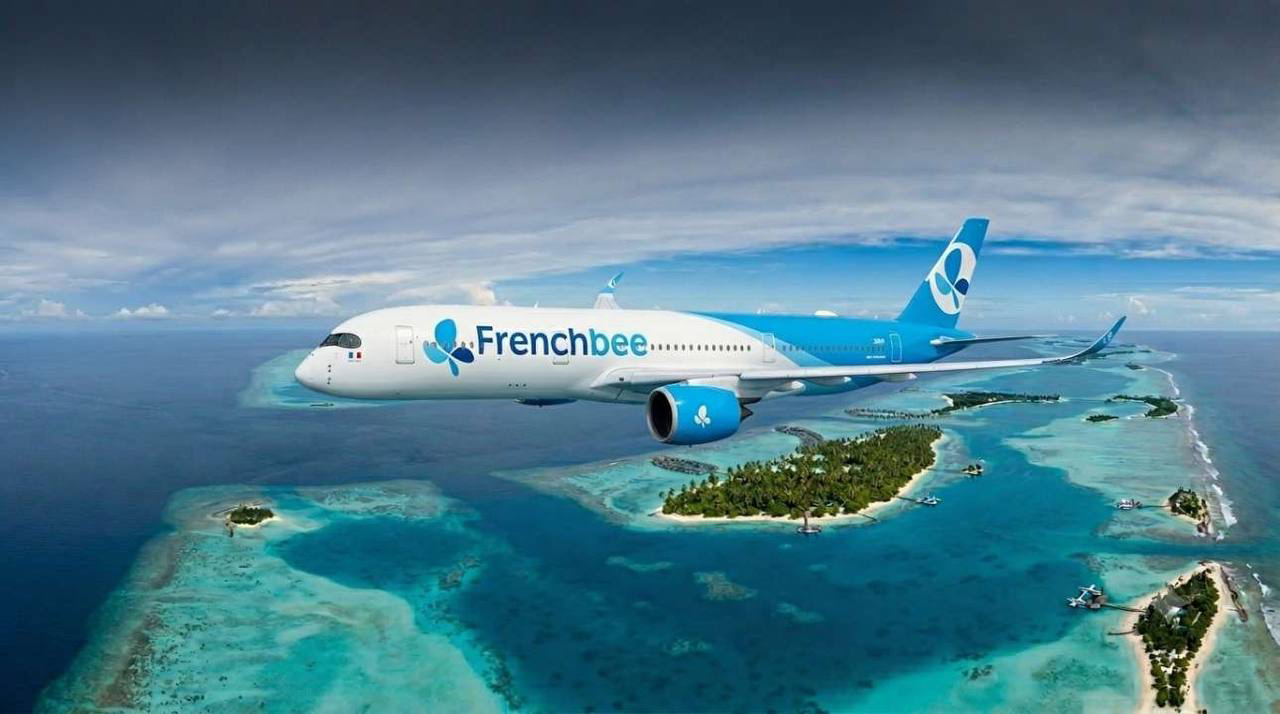
French Bee is pushing deeper into the Indian Ocean, opening sales on a new seasonal service that links Paris-Orly with both Malé and Colombo on a single triangular rotation. The first flight departs 19 December 2026, with the programme running through 2 May 2027, and, like most new long haul launches, it remains subject to government approval.
Rather than fly two separate point-to-point routes, French Bee will operate one continuous loop: Paris-Orly to Malé, a short hop across to Colombo, and back to Paris. Passengers can book either leg on its own or string both island markets into a single trip. For a carrier with a small fleet and a strict cost discipline, the triangle is an efficient way to test two unproven markets on one aircraft tail.
The Route Mechanics
The rotation will be flown by an Airbus A350-900, the smaller of the two A350 variants in French Bee’s fleet, configured in a high-density 411-seat, two-class layout: 35 Premium Blue reclines and 376 economy seats in a ten-abreast arrangement. Scheduling data circulated by AeroRoutes shows flight B%770 leaving Orly at 19:30, reaching Malé at 09:25 the following morning, then continuing to Colombo after about 90 minutes on the ground before turning back to Paris.
That routing produces a punishing return profile. Because aircraft heading north and west into prevailing headwinds burn more time in the air, Simple Flying’s analysis put the total Malé-Colombo-Paris block at close to 15 hours: a genuinely long day even by ultra-long-haul standards, and a reminder of what French Bee’s economics asks of its cabin. The carrier’s pitch leasn on the A350’s fuel burn: the type delivers roughly a quarter less fuel consumption and carbon dioxide, per seat than the previous widebody generation, which is the lever that makes a dense, low-fare long-haul model viable in the first place.
The frequency plan is deliberately elastic, scaling up and down with the winter season:
- 19 Dec 2026 – 10 Jan 2027: two weekly triangular flights over the Christmas and New Year peak
- 11 Jan – 7 Mar 2027: two weekly triangular flights plus a standalone direct Paris-Colombo service
- 8 Mar – 28 Mar 2027: one weekly triangular flight plus the direct Colombo rotation
- 29 Mar – 2 May 2027: two weekly direct Paris-Colombo flights, with the Maldives leg dropped entirely
The Maldives leg is front-loaded onto the holiday peak and then quietly retired by spring, while Colombo survives the whole season and ultimately gets the aircraft to itself.
Fares and the Value Proposition
Introductory return fares start at €599 in Eco Blue and €1,365 in Premium Blue for Colombo, and €649 in Eco Blue and €1,399 in Premium Blue for Malé.
CEO Marc-Antoine Blondeau framed the launch as a fit with the airline’s “growth strategy”, arguing that both destinations remain underserved by direct flights from France and that the pairing lets French Bee capture two complementary traveler profiles at once.
Walking into a Contested Market
This is a crowded corridor French Bee is stepping into: it is the third carrier to target French-Maldives service for the same winter.
Air France is returning to Malé on 18 December 2026, one day ahead of French Bee, with twice-weekly A350-900 flights from Paris-Charles de Gaulle running into March — a full-service product with a lie-flat business cabin. Separately, the Maldivian premium start-up Beond has lined up all-business-class service from Paris via a Dubai technical stop.
Why the Timing Matters
The launch lands at an awkward but opportune moment for the Maldives. The destination crossed one million arrivals in 2026 on pace with the prior year and is chasing an ambitious government target of roughly 2.5 million visitors for the year. Yet arrivals have wobbled: official figures showed a mid-single-digit decline through the spring, and much of the strain traces back to aviation, not the destination’s appeal.
For decades, European travelers have reached Malé on one stop through Gulf super-connectors. Disruptions across Middle-Eastern transit hubs and a sharp spike in jet fuel costs through 2026 thinned that connecting capacity, breaking the link for exactly the European honeymoon-and-resort traffic the Maldives depends on.