

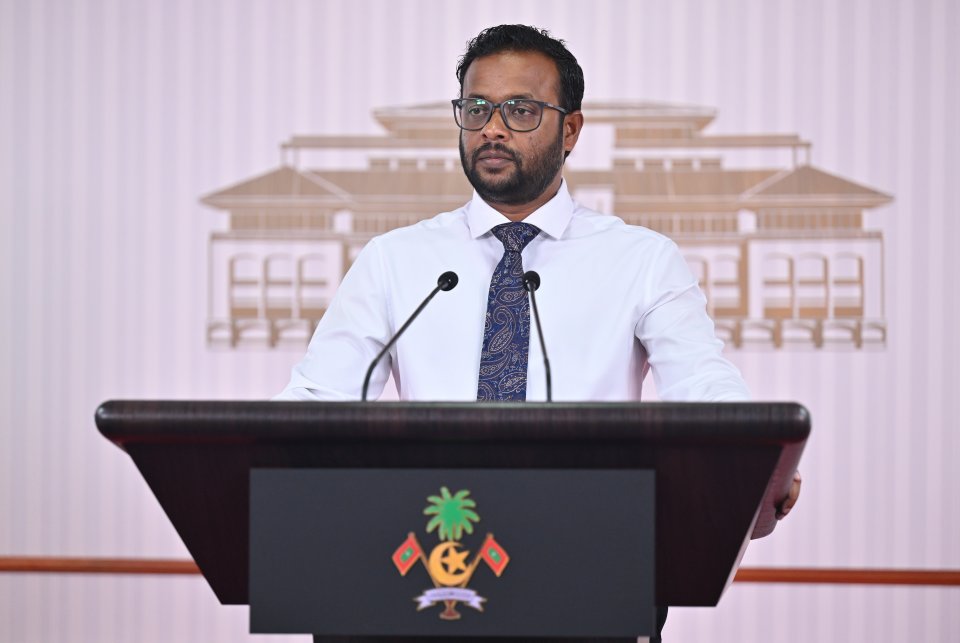

In one of the most candid admissions by a sitting Maldivian minister on the state of the country’s reclamation pipeline, Minister of Construction, Housing and Infrastructure Dr. Abdulla Muththalib disclosed this week that of all the islands and lagoons reclaimed across the archipelago since 2010, only two have actually been put to productive use.
Every other reclaimed parcel, including high-profile sites in the Greater Malé region and across the outer atolls, remains effectively stranded: dry land on a map, but without the water, sewerage, electricity, or road networks needed to make it livable or investable.
Speaking at a press conference at the President’s Office on 23 April, Dr. Muththalib singled out Lh. Hinnavaru as the starkest example. The land there was reclaimed nearly 16 years ago, in 2010, and to this day has none of the basic utilities that would allow housing, commerce, or service to take root on it.
“Our immediate priority is to complete these essential services as quickly as possible,” the minister told reporters.
The Business Problem: Reclaimed but not Ready
For developers, contractors, and SOE boards, the minister’s statement crystallizes an open secret of the Maldivian property and construction market: reclamation has outrun servicing by more than a decade.
The economic consequences are significant:
- Dead capital on sovereign and SOE balance sheets: Reclamation typically costs USD 15-40 per cubic meter of sand, meaning hundreds of millions of dollars of public money are currently sitting in unusable plots.
- Delayed housing supply in a market where Malé density and housing affordability are consistently ranked among the worst in South Asia.
- Lost resort, industrial, and logistics revenue from parcels that could otherwise host bonded warehousing, light manufacturing, or tourism assets.
- Deferred municipal revenue: No utilities means no connections, no rates, no lease-up.
The New Playbook: SOEs as Infrastructure Contractors
With the foreign debt window narrowing, Dr. Muththalib signalled a decisive pivot in how the government intends to finish the job.
Rather than tendering every water, sewerage, power, and road package to international EPC contractors, and raising dollar debt to pay for them, the ministry is actively exploring State-Owned Enterprises (SOEs) as the primary delivery vehicle for servicing these reclaimed lands.
The logic is straightforward:
- Cost compression: SOEs such as Fenaka Corporation (utilities), MWSC (water and sewerage), Road Development Corporation (RDC), Housing Development Corporation (HDC), and STO/MTCC (materials and marine works) can execute in Rufiyaa, avoiding FX leakage.
- Balance-sheet arbitrage: SOE capex can be financed through retained earnings, domestic bank lines, and Maldives Monetary Authority (MMA)-supported Sukuk, sidestepping expensive sovereign external borrowing.
- Design-phase underway: The minister confirmed that projects on multiple islands have already been assigned to various companies, which are currently in the design stage to make the parcels functional.
This is, in effect, a government-to-SOE infrastructure contracting model, and it is likely to reshape the order book of every domestic construction and utility SOE over the next 18 – 24 months.
The Foreign-Debt Squeeze Behind the Shift
Dr. Muththalib was unusually direct about the macro backdrop forcing the pivot:
“Securing foreign loans for projects of this scale has become a significant challenge under the current economic climate.”
That single sentence captures the reality facing the Treasury: with global interest rates still elevated, Middle East conflict risk repricing emerging-market paper, and the Maldives’ own external debt ratios under close watch by the IMF and rating agencies, new dollar borrowings for non-revenue-generating infrastructure are effectively off the table.
Servicing reclaimed land is classic “social infrastructure”, it generates welfare, not hard-currency cash flow. Funding it through SOEs, in Rufiyaa, is therefore not a preference. It is a necessity.
What to Watch Next
For investors, suppliers, and SOE-watchers, three signals will tell you whether the new model is working:
- Hinnavaru first: If water, sewer, power, and roads are tendered or assigned to SOEs on Hinnavaru within the next two quarters, it confirms the 16-year backlog is genuinely being unlocked.
- SOE capex guidance: Watch Q2 and Q3 2026 disclosures from Fenaka, MWSC, RDC, HDC, and MTCC for step-changes in project pipelines and capex plans.
- Materials demand: Cement, aggregates, pipes, cables, and roofing, i.e. order books at Raysut Maldives Cement, STO, and MSP should see measurable uplift if the servicing programme moves from design to construction on multiple islands simultaneously.
The minister’s admission is uncomfortable but constructive. For 16 years, the Maldives has been reclaiming faster than it has been servicing, creating a growing inventory of unusable land and tied-up capital. The current administration’s answer is to complete, not create: finish what’s already reclaimed, do it through SOEs, and do it in Rufiyaa.
If executed, it would be one of the largest shifts in the Maldivian domestic construction economy in a decade, and a rare case of fiscal constraint producing a better, more self-reliant delivery model.