

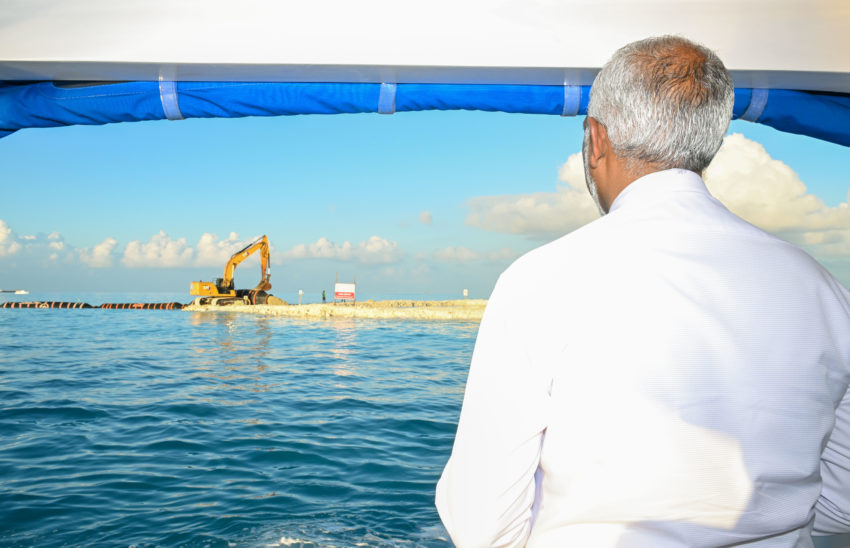

The Maldives has quietly crossed a major milestone in its most ambitious urban expansion of the decade. Dredgers at Fushi Dhiggaru Falhu have now pumped up 504 hectares of new land, more than half of the planned footprint of Rasmalé, the next-generation city rising next to Malé.
A New City, Already Bigger Than Hulhumalé
Dr. Abdulla Muththalib, Minister of Construction, Housing and Infrastructure, revealed the latest figures at a press conference today. He framed the scale in terms every Maldivian can picture instantly.
“The 504 hectares reclaimed so far roughly equals the combined area of Hulhumalé Phase 1 and Phase 2.”
In other words, the country has already built a second Hulhumalé, and the project still has nearly half its footprint to go.
The Numbers That Matter
- Total target area: 1,153 hectares
- Reclaimed to date: 504 hectares (≈ 44% by area, but over 50% of the active reclamation programme the minister referenced)
- Launch date: December 2023
- Location: Fushi Dhiggaru Falhu, adjacent to Greater Malé
- Status of applications: Open to the public for plots and housing units
Timeline: Tight, But on Track
Minister Muththalib acknowledged that the schedule may shift slightly. However, he pushed back firmly on any suggestion of slippage. Crews continue to work on the remaining lagoon sections, and the ministry expects reclamation to reach a handover-ready stage in step with the allocation process.
“By the time we finalize applications and select beneficiaries, we expect enough lands to be ready to formally allocate and hand over to recipients,” the Minister said.
Therefore, the sequencing is deliberate. Reclamation, application processing, and allocation all move on parallel tracks rather than in sequence. Consequently, the government avoids the classic Maldivian infrastructure trap: land sitting idle for years after it emerges from the sea.
Why Rasmalé Matters for the Economy
Rasmalé is not just a housing project. It is effectively a new urban economy next to the capital. Three implications stand out:
- Housing supply shock: Greater Malé suffers from some of the worst density and affordability metrics in South Asia. Adding 1,153 hectares materially changes that equation.
- Construction pipeline: Once plots transfer to beneficiaries and developers, the country should see a multi-year uplift in demand for cement, aggregates, steel, cables, and fit-out materials. Domestic suppliers and SOEs such as STO, MTCC, and Raysut Maldives Cement stand to benefit directly.
- Fiscal signaling: Rasmalé moves ahead even as the government tightens foreign borrowing. That tells investors the administration will prioritize flagship domestic projects through Rufiyaa-denominated and SOE-led delivery models.
Rasmalé vs. the Wider Reclamation Backlog
The Rasmalé update also lands in sharp contrast to the minister’s earlier admission that only two of the Maldives’ post-2010 sites are actually in use. Rasmalé, clearly, is designed not to join that list. The ministry is sequencing utilities, allocation, and design work alongside dredging, precisely to avoid another Hinnavaru-style 16-year gap between reclamation and habitation.
What to Watch Next
- Utilities tenders for water, power, sewerage, and roads on the reclaimed sections
- Allocation announcements once the current application window closes
- Developer partnerships for mid-rise housing, commercial plots, and mixed-used zones
- Capex guidance from listed and state-owned construction suppliers over the next two quarterly cycles
Rasmalé has crossed its halfway mark, and it did so faster than most observers expected when dredgers first arrived at Fushi Dhiggaru Falhu in December 2023. Moreover, the government is pairing reclamation with allocation and servicing in parallel, a sharp departure from past practice. If the ministry holds this line, Rasmalé will become the model for how the Maldives delivers land in the next decade: on time, in Rufiyaa, and ready for use on day one.