

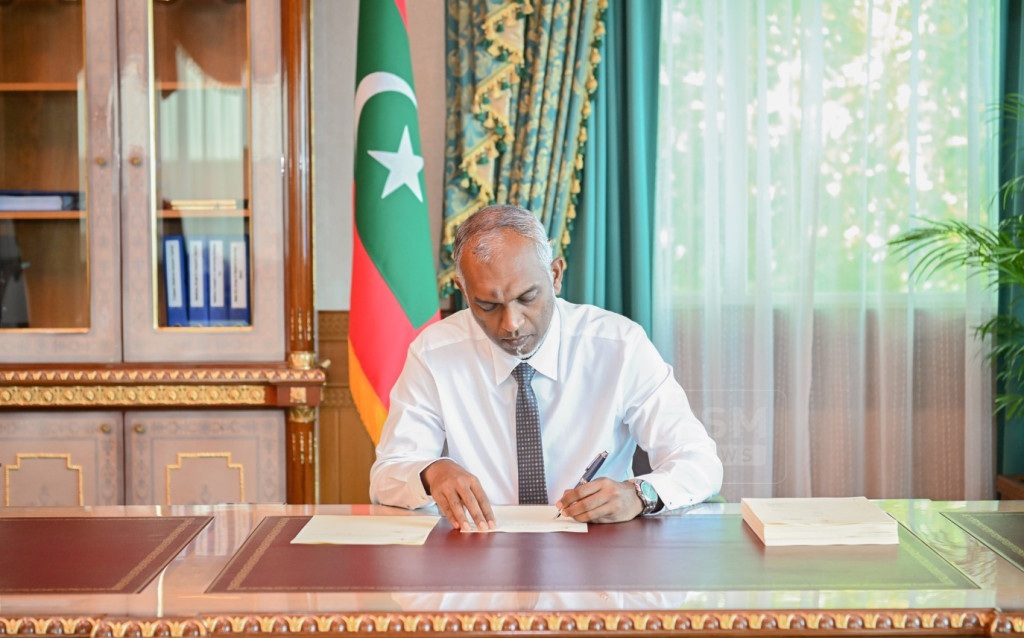

President Dr. Mohamed Muizzu has signed a new Presidential Decree governing cross-subsidy investment in the Maldives.
The decree sets out which projects qualify for cross-subsidy arrangements and establishes the minimum investment thresholds contractors must meet to participate.
The Maldives Tourism Act requires the government to publish these thresholds annually in the Government Gazette. This decree fulfills that obligation.
What the Decree Governs
The decree attaches an annex listing eligible projects and their corresponding investment minimums. The list spans a wide range of development priorities including land reclamation for tourism and public use, prison development, airport expansion, social housing, island causeways, and utility infrastructure in newly dredged areas covering water, electricity, sewerage, and waste management.
Chief Government Spokesperson Mohamed Hussain Shareef told PSM News that the President’s Office made only minor changes from last year’s resolution. The key difference this year is the framing. Rather than listing individual projects, the government now describes eligible initiatives in broader, more flexible terms. This gives the government room to adapt as development priorities shift, while maintaining clear investment benchmarks.
Investment Regime
Cross-subsidy investment is a central mechanism in the Maldives’ development financing model. Under this structure, private contractors receive rights to develop income-generating assets, typically tourism properties, in exchange for funding or delivering designated public infrastructure. The state does not bear the upfront capital cost. Instead, the contractor’s return comes from the commercial asset.
This model has driven significant infrastructure delivery across the country. It sits within a broader investment policy framework targeting tourism growth, climate resilience, national security infrastructure, and social development.
The revised decree aims to draw greater private-sector participation, bring transparency to cross-subsidy resource allocation, and accelerate project delivery under the government’s development agenda.