

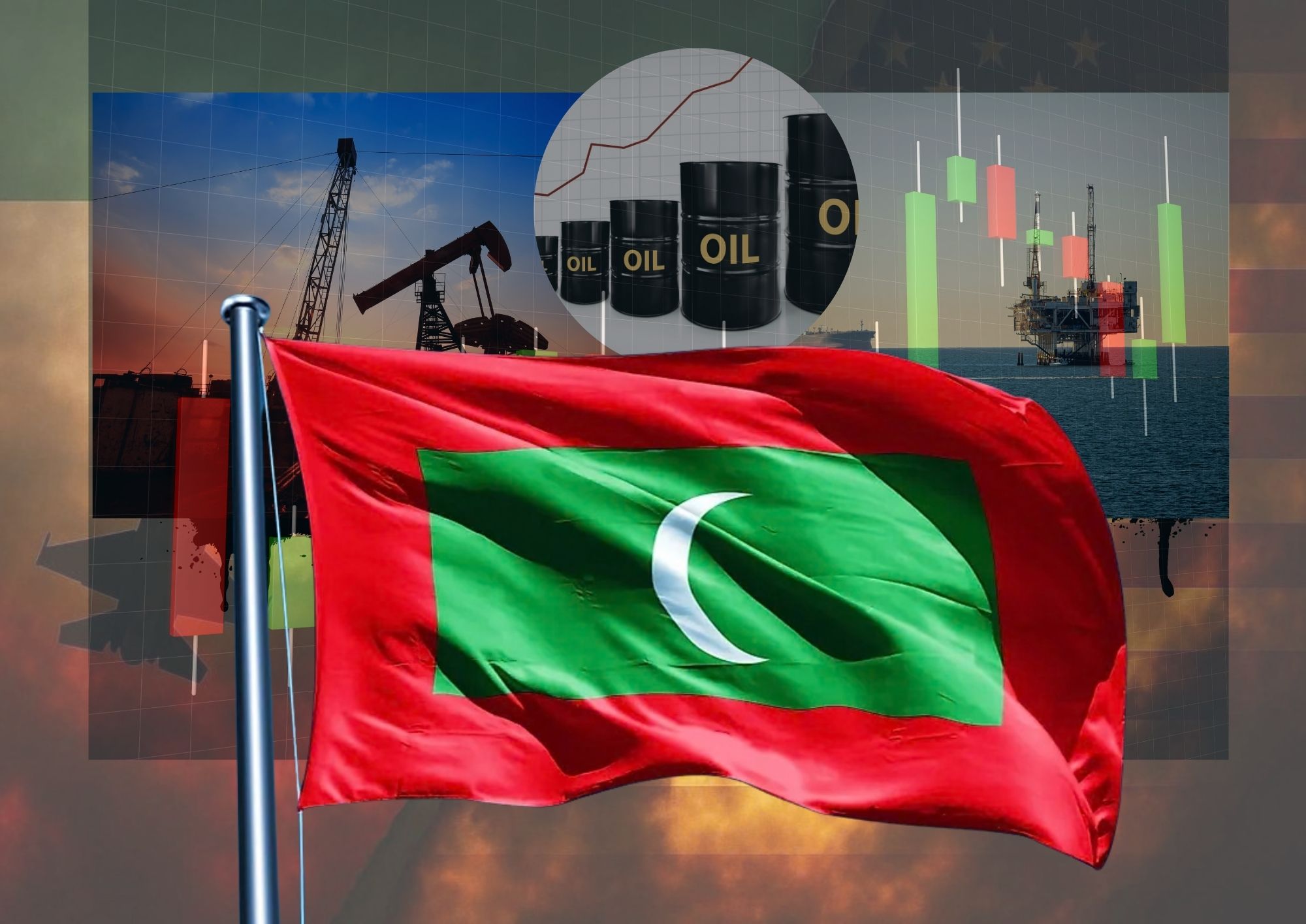
[Disclaimer: The following is a submission from one of our most esteemed readers and do not reflect the views or editorial policies of the Maldives Business Times, however, to ensure journalistic and correspondence freedom and integrity, the identity of the contributor will remain anonymous as per their wishes.]
There is a peculiar habit among small island governments when confronted with the first tremors of a global economic earthquake: they issue reassurance. They convene press conferences. They point to agreements signed, tankers en route, and reserves held, and then, sometimes months or years later, the full weight of what they dismissed as a distant problem arrives on their shores, and there is nothing left to do but manage the wreckage.
The Maldives, in March 2026, is doing exactly this.
As the US-Israeli war on Iran enters its third week, global oil markets have been shaken to their foundations. The Strait of Hormuz — through which roughly one-fifth of the world’s oil and a similar share of liquefied natural gas ordinarily flows — has been effectively shut down. Brent crude, which opened the year around $70 per barrel, has surged past $110 and some analysts are pricing in scenarios north of $150 if the conflict persists. The State Trading Organization (STO), the government’s commercial arm and the country’s major fuel importer, has already raised petrol prices by 18.6% and diesel by 26% at the pump. The Minister of Finance Moosa Zameer has told the public that the government is monitoring the situation carefully, that supply is secured, that tankers are in transit, and that STO profits will be used to subsidize fuel costs. President Muizzu has noted that Oman remains the primary supplier, and that an oil tanker had already departed for the Maldives.
What the government has considerably less forthcoming about is the extraordinary degree to which this country — already navigating what the Finance Minister himself called ‘the most difficult year in terms of debt in the country’s history’ — is exposed on every conceivable front.
The Maldives imports virtually everything it consumes. It produces almost nothing it needs. And the engine that pays for all of it, tourism, now runs through the very airspace that war has closed.
This is not merely an oil story. It is a story about what happens when a debt crisis, a fuel shock, a tourism collapse, and a broken global supply chain converge simultaneously on one of the most import-reliant nations on the planet. It is a story the government is not yet telling its people. It deserves to be told.
The Anatomy of a Dependent Economy
To understand why the Maldives is so acutely vulnerable to what is happening in the Persian Gulf, one must first appreciate the structural architecture of its economy, an architecture that has no real parallel among middle-income nations.
The Maldives is a country of roughly 1,200 coral islands scattered across 90,000 square kilometers of the Indian Ocean. It has no significant agriculture. No manufacturing. No mineral wealth. No energy resources. Its fisheries, once the cornerstone of the national economy, have been marginalized by declining catches and poor export pricing. What it has, in extraordinary abundance, is one of the most desirable natural environments on earth: turquoise lagoons, pristine reefs, and the kind of tropical isolation that the ultra-wealthy are willing to pay extraordinary sums to access.
Tourism accounts for roughly 30 percent of GDP directly, and well over 60 percent when indirect contributions such as construction, retail, transport, and utilities are included. The country welcomes close to two million visitors annually. In the first two months of 2026 alone, 473,000 tourists arrived, before the war stopped that flow almost ovenight.
But tourism is not just the country’s income. It is the country’s oxygen. Every dollar of usable foreign exchange, every Maldivian Rufiyaa spent on public salaries, every subsidy the government extends to keep fuel and food affordable for ordinary Maldivians; all of it ultimately traces back to resort bed-nights and dive packages and seaplane transfers. When tourism sneezes, the Maldivian state catches pneumonia. When tourism collapses, the state faces a liquidity crisis that can metastasize into a solvency crisis with alarming speed.
Meanwhile, on the import side, the picture is equally stark. The World Bank has estimated that fuel alone accounts for around 22 percent of the Maldives’ total import bill; approximately 11 percent of nominal GDP. The country’s electricity is generated almost entirely from diesel generators. Marine transport between the 200 inhabited islands is diesel-powered. The fishing fleet runs on fuel. The desalination plants that provide drinking water to the atolls run on fuel. Every resort’s power system, every seaplane, every speedboat taxi — fuel, fuel, fuel.
Without a steady, affordable supply of petroleum products, the Maldivian economy does not slow down. It stops.
The Ghosts of Oil Shocks Past
The Maldives is not encountering the consequences of a global oil price shock for the first time. History offers several instructive episodes, and in each case, the pattern was the same: official reassurance, followed by painful reality, followed by a period of fiscal emergency that left lasting damage.
The 2008 oil shock, when Brent crude climbed from around $70 per barrel at the start of the year to a peak of $147 in July, struck the Maldives a moment of political transition. The country was preparing for its first multi-party elections, and the government was in no position to confront the public with the full implications of what was happening. Fuel subsidies ballooned. The fiscal deficit widened sharply. Foreign exchange reserves came under pressure. The democratic transition proceeded, but the new government of President Mohamed Nasheed inherited a fiscal position that had been hollowed out by the commodity shock and the subsequent global financial crisis, which crushed tourism revenues just as the fuel shock had inflated expenditures.
President Nasheed’s response; attempted liberalization of the energy sector, efforts to reduce diesel dependence through renewable energy investment, and a controversial international climate advocacy campaign, was ultimately cut short by political instability. But the fundamental structural problem he identified remained. The economy’s exposure to global oil prices was not reduced. The diesel dependency was not broken and the fiscal architecture that made subsidies politically indispensable, but economically unsustainable, was left intact.
The 2011 Arab Spring oil price spikes brought a second wave. The uprisings in Libya and elsewhere pushed Brent over $120 per barrel for an extended period. Again, the Maldives felt the pressure through its import bill, its subsidy obligations and, critically through the secondary effect on tourism. European tourists, whose spending power was being squeezed by higher energy costs and the eurozone sovereign debt crisis, reduced discretionary spending on long-haul holidays. The Maldives’ arrivals growth slowed which softened the revenue and thus contracted the fiscal space.
The Russia-Ukraine war of 2022 provided the most recent lesson. Global energy prices surged and the Maldives, like many import-dependent nations, faced a sharp increase in its fuel import bill at precisely the moment its post-COVID recovery was beginning to gather pace. The World Bank, in its October 2022 assessment, noted that rising global commodity prices were increasing pressures on domestic inflation, the government’s fiscal position, and the balance of payments, and that blanket subsidies on fuel and staple foods were expected to keep recurrent spending elevated.
The Maldives government was urged to reform its subsidy framework and adopt more targeted transfers. Those reforms were promised, but delayed and have still not been implemented at the scale required.
Every time oil prices have surged for a prolonged period in living memory, the Maldives emerged poorer, more indebted, and more dependent on the same fragile structure that made it vulnerable in the first place.
This historical pattern is therefore consistent and concerning: every time oil prices have surged for a prolonged period in living memory, the Maldives has emerged poorer, more indebted, and more dependent on the same fragile structures that made it vulnerable in the first place. There has been no structural break and no diversification. No reduction in the country’s fundamental exposure.
What has changed — significantly — is the level of debt, and that changes everything about how this crisis will unfold.
The Sukuk Time Bomb
The current crisis arrives at a moment of exceptional fiscal fragility, one that the government has been managing through a combination of confidence projection, diplomatic shuttling, and financial engineering, but which has not been resolved.
In April 2026, the Maldives is due to repay a $500 million sukuk bond issued in 2201 at a profit rate of 9.875 percent. Together with the final coupon payment on the sukuk and a $100 million loan from the Abu Dhabi Fund maturing simultaneously, total obligations in April alone could reach $625 million. To put that in context: the country’s usable foreign currency reserve stood at approximately $197 million as recently as November 2025.
The IMF, in its 2024 debt sustainability analysis was blunt: external refinancing pressures were expected to peak in 2026, with higher amortizations and large interest payments triggering ‘protracted breaches in several debt indicators’ leading to the assessment that debt was “not sustainable under the authorities’ current policies”. The Fund projected foreign exchange reserved could fall to approximately 1.1 months of import cover at the peak of external debt servicing, a level that most international standards regard as dangerously inadequate.
In total, the Maldives faces over $1 billion in external debt repayments in 2026 alone — more than 11 percent of GDP. The national debt crisis, which stood at roughly $3 billion in 2018, has ballooned to $8.2 billion as of 2024, equivalent to around 122 – 135 percent of GDP depending on the measure used. The Sovereign Development Fund, which was supposed to serve as a buffer for the sukuk repayment, held only around $126 million in November 2025, a fraction of what is needed.
The government has been working to refinance $350 million of the sukuk while repaying $150 million from the SDF, and Finance Minister Zameer expressed confidence in Parliament that the mechanism to pay was in place. But ‘in place’ and ‘secured’ are different things, and the Iran war has now fundamentally altered the external financing environment in which those plans were to be executed. The Gulf states that the Maldives had been courting for budget support — the UAE, Saudi Arabia, Kuwait, Qatar — are now themselves under Iranian, managing their own economic crises, and in no position to extend discretionary bilateral support to a small Indian Ocean island nation.
The China-Maldives Free Trade Agreement, enacted in January 2025, has compounded rather than alleviated fiscal pressures. Import duties, a significant source of government revenue, have plummeted by 64 percent since the FTA came into force, while Chinese imports have dominated the benefit. The $1.3 billion that the Maldives owes China represents the single largest bilateral creditor exposure in its external debt portfolio, yet Beijing has been largely absent from the emergency financing discussions.
The Tourism Artery, Severed
If the debt picture is alarming, the tourism picture is catastrophic in the short-term, and the medium-term trajectory depends almost entirely on how long the conflict lasts.
The Maldives’ tourism market is structurally dependent on Middle Eastern aviation hubs in a way that is extraordinary even by the standards of Indian Ocean island destinations. European tourists, who account for more than half of all arrivals, reach the Maldives almost exclusively by transiting through Dubai, Doha, or Abu Dhabi. Emirates, Qatar Airways, Etihad, Gulf Air: these are not just airlines, but they are the Maldives’ connection to its primary source markets. When their hubs close, the Maldives is, for practical purposes, cut off from Europe.
That is precisely what happened on 28 February 2026. Within 48 hours of the US-Israeli strikes on Iran, Gulf airspace was largely closed. Nine flights were cancelled on the first day. Nineteen on the second. By the following Monday, 15 inbound flights from Middle Eastern airports had been cancelled. Thousands of tourists were stranded at Velana International Airport, sleeping on the floors of the old domestic terminal, waiting for flights that kept being rescheduled or cancelled. Minister of Tourism Thoriq Ibrahim confirmed that roughly 30 to 35 percent arrivals came via Middle Eastern flights.
Oxford Economics has modelled two scenarios: an early resolution of the conflict lasting one to three weeks, in which inbound arrivals to the Middle Easter, and connected destinations like the Maldives, decline by around 11 percent year-on-year in 2206; and a protracted scenario of one to two months, which produces a 27 percent decline. In spending terms, the global loss to the Middle East tourism ecosystem alone could reach $56 billion. For the Maldives, the proportional impact on dollar-denominated revenue, at the precise moment the country needs every dollar to service its debt, is devastating.
The World Travel and Tourism Council has estimated the Middle East aviation and tourism complex is losing at least $600 million per day in international visitor spending since the conflict began. The Maldives is collateral damage in this calculation, but damage nonetheless.
What makes this particularly dangerous is the timing. The Maldives was counting on strong 2026 tourist revenues to flow through the government revenue through the Tourism Goods and Services Tax (TGST) and Green Tax, the primary mechanisms by which resort dollars become government Rufiyaa. A sharp reduction in arrivals means a sharp reduction in these tax receipts, coming at the very moment the government needs to demonstrate fiscal credibility ahead of the April sukuk repayment.
Supply, the Strait, and the Oman Lifeline
The government’s position on fuel supply has been consistently reassuring, STO’s Managing Director Shimad Ibrahim has noted that the Oman agreement provides both financial flexibility and product security. Finance Minister Zameer has pointed out that Oman’s ports lie outside the Strait of Hormuz: meaning that, unlike the bulk of Gulf oil exports, Omani crude and refined products can reach tankers without transiting the waterway that Iranian forces have effectively blockaded.
This is true, and it matters. The STO’s February 2026 agreement with OQ Trading, securing a medium-term structured finance facility alongside a mid-to-long-term supply arrangement for light and middle distillate products, represented genuine prudence. STO operates two owned tankers, a 24,500 metric ton vessel and a 22,000 metric ton vessel, keeping fuel perpetually in transit. The Funadhoo terminal in Kaafu atoll holds storage capacity for 291,000 barrels of diesel and 59,000 barrels of gasoline, providing some buffer against supply disruptions.
But the government’s framing obscures three critical points. First, even if Oman can continue supplying the Maldives physically, it cannot supply it at the pre-war price. Global oil prices have already surged more than 25 percent since the conflict began. Brent briefly touched $120 per barrel during the conflict’s first days and has remained highly volatile. The Maldives’ fuel import bill, already consuming 22 percent of total imports and 11 percent of GDP at pre-war prices, is being repriced in real time, with every increase flowing directly through the government’s subsidy obligations.
Second, Oman is not insulated from the conflict. Iranian attacks have targeted energy infrastructure across the Gulf region. Saudi Aramco’s Ras Tanura refinery and crude export terminal closed due to Iranian strikes. Qatar declared force majeure on its LNG exports after Iranian drone attacks. Oman, while not a direct military target, shares a maritime border with the Strait of Hormuz, and the elevated risk profile for shipping in the region has caused insurance and freight costs to spike dramatically: costs that ultimately flow through to the landed price of fuel in Male’.
Third, and perhaps most importantly: the Maldives is already paying for fuel in a currency — US Dollars — that it has very little of. Every dollar spent on fuel at elevated prices is a dollar not available for debt servicing. The two crises are not parallel, but they are competing for the same scarce resource: foreign exchange.
The Inflation Transmission Mechanism
Oil price shocks do not affect the Maldives only through the direct cost of fuel imports. They transmit through the economy in ways that are broader, slower, and harder to manage with subsidy tools.
Consider food. The Maldives imports the vast majority of its food, rice, flour, sugar, cooking oil, canned goods, fresh produce, poultry, dairy. The global food supply chain runs on oil. When oil prices surge, freight costs rise, agricultural input costs rise, food processing costs rise. The global food price index, which had already been elevated by the Russia-Ukraine war’s disruption of Black Sea grain exports, is now being repriced upward again. For a country where food and non-alcoholic beverages amount for 22 percent of the consumer price index, and where the World Bank has noted that food price inflation poses particular distributional concerns because poor households spend more than a third of their budget on food, this is not a minor concern.
Consider construction. The Maldives has been in the midst of an infrastructure investment surge — the Velana International Airport expansion, the Greater Male’ connectivity bridge, housing developments across the atolls. All of these projects require cement, steel, roofing materials, and plant equipment, all of which move on ships, and all of which are now more expensive to move. Capital expenditure, already constrained by financing difficulties, will face additional cost inflation.
Consider electricity. The outer islands are served by Fenaka Corporation, which operates diesel generators. Electricity is subsidized. When diesel prices rise, the subsidy bill rises. The government has committed to expanding solar-battery-diesel hybrid systems across the atolls, and progress has been made, but the transition is nowhere near complete.
The diesel dependency that makes electricity costly to the government budget has not been broken.
The net effect of these transmission channels is a broad-based inflationary pressure that the government cannot fully absorb through the STO cross-subsidy mechanism Finance Minister Zameer described. Cross-subsidizing fuel from STO’s profits is a mechanism designed for moderate price increases in a single commodity over a short period. It is not designed for a sustained, multi-commodity inflation shock in the context of a foreign exchange crisis and a looming $625 million debt repayment.
The Policy Trap
The Maldivian government is caught in a policy trap that has been decades in the making and which the current crisis has snapped shut.
The trap works like this: fuel and food subsidies are politically indispensable. Successive governments — Nasheed’s, Waheed’s, Yameen’s, Solih’s and now Muizzu’s — have maintained and expanded blanket subsidy programmes not out of ignorance of their fiscal cost, but because the political cost of removing them has always appeared higher than the fiscal cost of maintaining them. The World Bank has recommended, repeatedly and over many years, that blanket subsidies be replaced by targeted transfers to vulnerable households. Successive governments have agreed, in principle, that this reform is necessary. None has implemented it.
The consequence is that the government now faces a situation in which, to maintain fiscal sustainability, it needs to reduce subsidy expenditure; but to reduce subsidy expenditure it must raise fuel and food prices; but raising fuel and food prices in the context of a cost-of-living crisis triggered by a global oil shock is politically explosive; and political instability would undermine the confidence of the international creditors whose support the government needs to refinance its debt; and without that support, the April sukuk repayment is at risk. Every exit is blocked by every other exit.
The IMF option looms larger with each passing week. An IMF programme would provide the external financing anchor and the policy credibility that bilateral donors have been reluctant to supply. But IMF programmes come with conditionality — subsidy reform, fiscal consolidation, structural adjustments — that have historically triggered protests in the Maldives. The government has thus far resisted engagement with the Fund, citing the temporary nature of the crisis. The temporary nature of the crisis is now considerably harder to sustain as a narrative.
Every exit from the policy trap is blocked by every other exit. The government’s room to manoeuvre has never been smaller.
What A Prolonged Conflict Means
The scenarios now being modelled by analysts at Chatham House, the World Economic Forum, and Oxford Economics suggest that even a relatively short conflict, resolved in two to four weeks, will leave lasting marks on the global economy through elevated oil prices, tightened credit conditions, and lingering tourism sentiment effects. A conflict persisting for several months could push Brent crude to $130 per barrel or higher, according to Chatham House estimates, with knock-on effects that could take years to fully unwind.
For the Maldives, a prolonged conflict creates a cascade of compounding problems. Tourism revenues would remain depressed through the peak March-April season and potentially into the summer, depleting the dollar receipts that were supposed to fund debt servicing. The fuel import bill would increase at a rate the government cannot fully pass on to consumers without triggering inflation and political backlash. The cross-subsidy mechanism using STO profits would be exhausted. The fiscal deficit, already projected at MVR 9.4 billion for 2026 and forecast to widen to 13 percent of GDP by 2026-27, would blow out further. Public debt, already at 135 percent of GDP, would move higher still.
The April sukuk repayment, already a cliffhanger under pre-war conditions, becomes considerably more precarious if the conflict is still unresolved when markets open for the final coupon and principal payment. Gulf sovereign wealth funds and bilateral creditors who were tentatively identified as sources of refinancing support are now occupied with their own emergencies. The window for completing a refinancing arrangement, always tight, is narrowing.
In the background, a structural concern that nobody in the government has adequately addressed: the China-Maldives relationship. China is the Maldives’ largest bilateral creditor, holding approximately $1.3 billion in debt. The Free Trade Agreement that came into force in 2025 has already dramatically reduced import duty revenues. Beijing has been largely passive during the current crisis. What that passivity means for the longer-term political economy of Maldives-China relations, and whether China’s financial leverage over the country will be exercised in ways that compromise sovereignty of Maldives or its alignment with democratic partners, is a question the government hat not answered publicly.
What Must Be Done
Optimism has its uses, and the government’s efforts to project confidence — STO’s supply agreements, the Oman partnership, the cross-subsidy mechanism, the finance ministry’s technical committee — are not without merit. Panic is not useful. But reassurance without honesty is its own form of failure.
What the Maldives needs right now is a government that is honest with its people about the scale of the challenge; that pursues subsidy reform with genuine urgency rather than electoral calculation; that engages transparently with the IMF about a programme that could provide the external anchor the country clearly; that accelerates the renewable energy transition that would reduce diesel dependency and ultimately break the transmission channel between global oil shocks and domestic economic distress; and that develops a credible medium-term fiscal framework that matches expenditure obligations to realistic revenue projects, not to optimistic ones.
The April sukuk repayment will either be made or it will not. If it is made, through a combination of SDF withdrawals, bilateral support, and market refinancing, it will buy time. But buying time is not the same as solving the problem. The Maldives has been buying time since 2018. The price of bought time now includes $8.2 billion in public debt, a structural current account deficit that is expected to remain above 18 percent of GDP through 2027, foreign exchange reserves that were covering barely 1.5 months of imports at the start of the year, and an economy structurally incapable of generating the domestic savings required to fund its own development.
The Middle East conflict will end. Oil prices will, eventually, moderate. Tourism will recover. But the Maldives will face the next oil shock, and there will be a next one, in the same structurally exposed position it faces this one, unless the policy choices that have been deferred for decades are finally confronted.
Paradise, in the end, is not an immunity to the world. It is a wager on it.
The Maldives placed that wager on a singular asset — the extraordinary natural beauty of a nation threatened, ironically, by the same fossil fuel consumption that is now pricing it out of economic stability. The bet has paid handsomely for a generation of political leaders and resort developers. The bill, in 2206, is arriving in the form of a gathering storm: higher oil prices, severed air links, a looming debt cliff, and a government still talking about tankers in transit while the weather turns.
The tanker will arrive. The question is what happens after.