

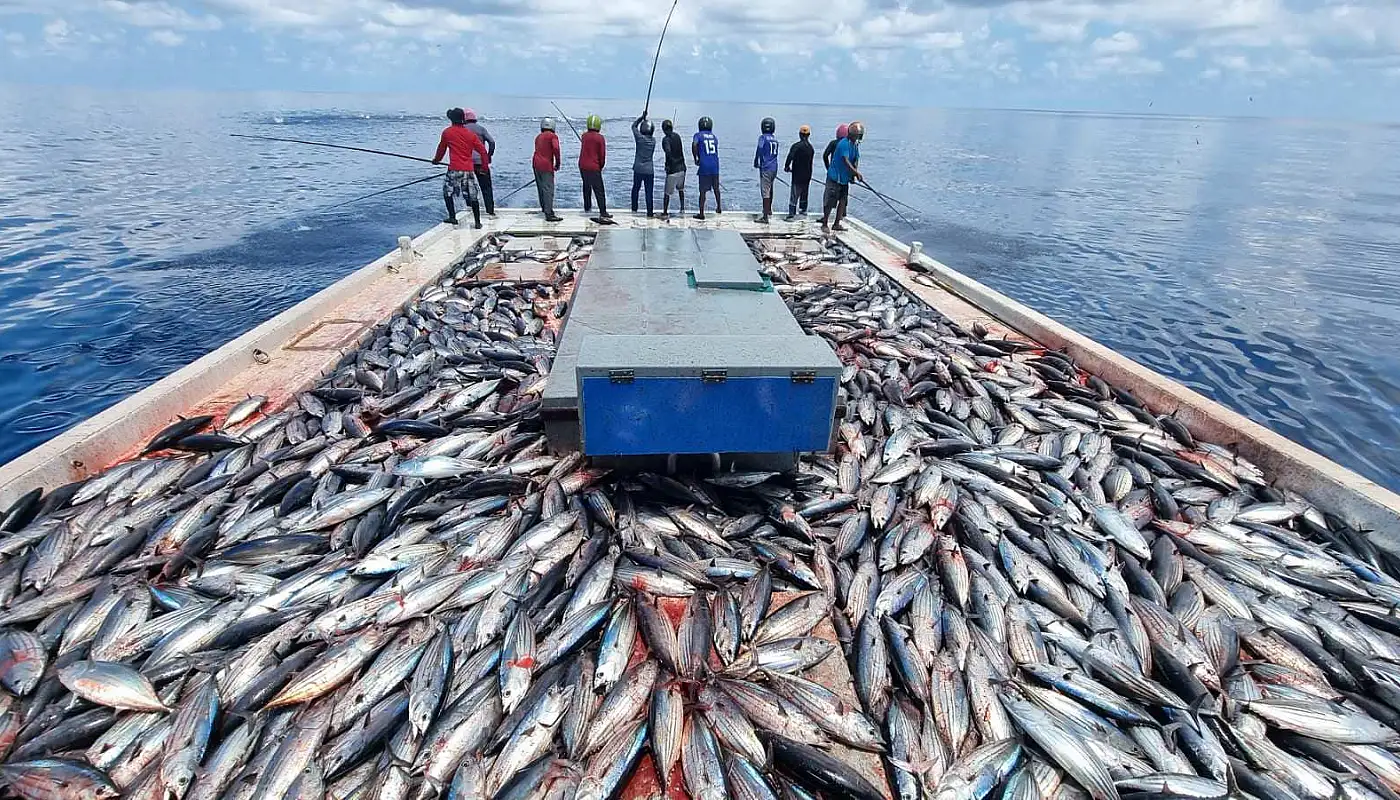

The Maldives Industrial Fisheries Company (MIFCO) has paid out more than MVR 10 million to fishermen during the first nine days of May, signaling that the country’s busiest tuna season continues to deliver strong volumes for the state-owned processor.
The MIFCO May fishermen payments figure stood at MVR 10,686,595 between May 1 to 9, according to the company’s latest statistics. Moreover, the disbursement pace tracks closely with the strong April performance, where total payouts cleared MVR 78 million for the full month.
A Single Day’s Settlement Tells the Story
A notable MVR 2,957,958 of the cumulative total was processed today alone, settling the catch landed on My 7. The single-day disbursement underscores the speed at which the company is now closing payment cycles. Furthermore, it reflects the operational rhythm the government has anchored its fisheries reform around: pay fast, capture the volume, keep the fleet at sea.
Skipjack tuna dominated the books, as it typically does. MVR 10,440,010 — about 97.7% of the total disbursements over the period — went to vessels landing skipjack. Yellowfin tuna in the over-15kg grade picked up MVR 230,825, while the 10kg – 15kg yellowfin grade received MVR 15,760.
The 48-Hour Pledge in Practice
The MIFCO May fishermen payments figure carries a backstory. President Dr. Mohamed Muizzu inherited an MVR 250 million payment backlog from the previous administration when he took office. The government cleared that legacy debt and then introduced a 48-hour payment commitment for fishermen: a structural shift unveiled on Fishermen’s Day 2024.
Under the new arrangement, MIFCO settles payments within 48 hours of fish being weighed at the company’s facilities. Consequently, fishermen no longer carry receivables for weeks or months, which had previously distorted vessel-level cash flow and discouraged consistent landings.
MIFCO says the change has lifted both catch volume and export throughput. The arithmetic supports the claim. Faster cash recycling allows fishermen to refuel, restock provisions, and head back out without financial drag, which in turn keeps processing lines running closer to capacity.
Pricing Reforms Continue to Reshape Economics
The government has paired the payment-speed reform with two pricing levers. First, MIFCO’s purchase rate for skipjack tuna sits at MVR 16 per kilogram. Second, fuel sold to fishermen has been reduced to MVR 13 per litre. Therefore, the cost-revenue spread on each fishing trip has been deliberately widened to improve fleet-level economics.
The yellowfin programme adds a further income channel. MIFCO began purchasing yellowfin tuna in January in line with a presidential commitment. Procurement of the over-15kg grade started on 11 January, and the 10kg – 15kg grade followed on January 21. The company currently buys yellowfin at MVR 25 per kilogram — a meaningfully higher price point than skipjack, giving fleets that target the species an upside lever that did not exist a year ago.
What the Numbers Signal
Nine days of activity is too short a window for sweeping conclusions, but the trajectory is consistent with what April delivered. If the current daily run-rate holds, May payments could land in the same MVR 70 – 80 million range as April. Furthermore, the fact that MIFCO is settling individual day’s catches within roughly two days reinforces the credibility of the 48-hour commitment as a sustained operational reality, not a launch-day promise.
For the wider fisheries sector, the MIFCO May fishermen payments print continues to feed a coherent narrative. Volumes are strong, payments are timely, and pricing is structurally more favourable than under the old regime. The next watch-point sits with export performance — whether the increased landings translate into stronger overeseas shipments and, ultimately, into a healthier contribution from fisheries to the country’s merchandise export base.