

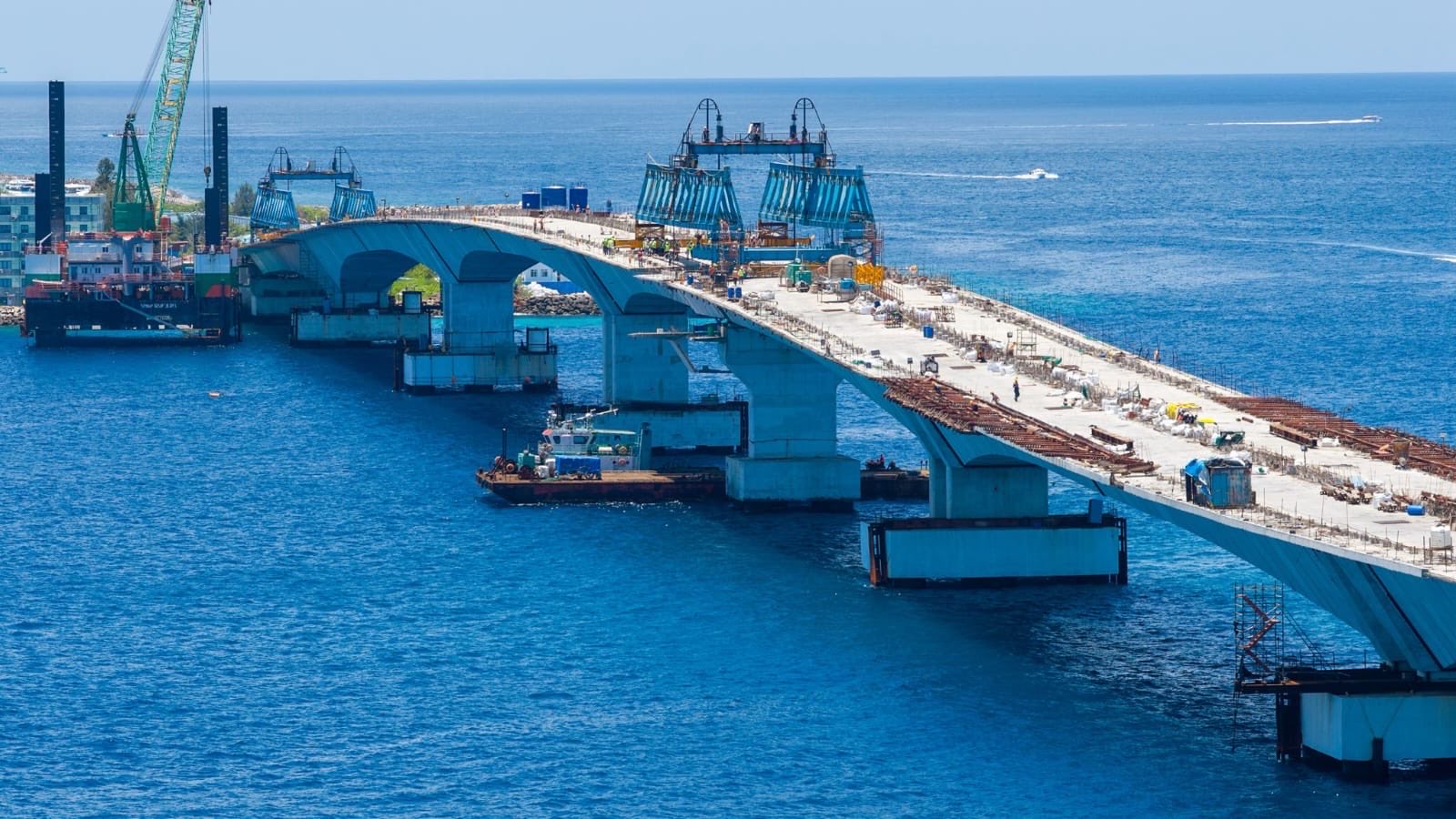

The bridge rising between Malé and Thilafushi has been engineered to stand for roughly 120 years. Major maintenance? Once every two decades, according to the Indian contractor building it.
S.M. Vishwamurthy, project head at AFCONS, told a local media outlet the structure was designed against strict durability and safety benchmarks, with the Maldives’ punishing marine conditions written into the assumptions from the start. High-grade materials meeting international standards make up the main structure, he said, which is why the core components are not expected to need frequent heavy repair. Wear will still come. Traffic and salt air see to that.
But the big interventions should fall about 20 years apart.
Wind was the other design problem. Engineers modelled the extreme gusts the bridge could face across its 120-year life and layered additional safety margins on top. Corrosion got its own treatment: the railing system uses specialized stainless steel chosen to resist seawater and salt-laden air.
The design did not stay in-house. Independent reviews and verification involved internationally recognized engineering firms, Arup among them. AFCONS said concrete, steel and other materials undergo routine testing and quality control against the required standards.
Three-Quarters Done
Overall progress now sits at 77 percent. The main structural works are further along at roughly 90 percent, and the final segment between Malé and Vilimalé has been launched, physically joining the two islands for the first time.
What remains is the unglamorous part: remaining structure, finishing works and associated infrastructure. AFCONS is targeting completion by the end of next year.
Opening day comes later, and only on conditions. Vishwamurthy said the bridge will not carry traffic until every required inspection, test and safety assessment is signed off, and that the project team intends to meet the highest applicable safety standards before the public drive across.
Once it does open, the link will run continuously from the capital through Vilimalé to Gulhifalhu and Thilafushi, tying Malé to the industrial and urban land where much of the country’s future development is planned.